Tsim Sha Tsui vs Central: Which Hong Kong Business District Makes More Sense For Your First Office
Feb 25, 2026
Hong Kong remains one of Asia’s most influential business cities. Its business districts are diverse, dynamic, and highly competitive. One look around, and you’ll quickly realize that every neighborhood feels like its own ecosystem.
Knowing what each area brings to the table is the first step to finding a location that aligns with your company’s vision and long-term goals. Hong Kong offers no shortage of prime addresses, but two districts consistently top the list for ambitious new entrants: Tsim Sha Tsui and Central.
So, where should you set up your first office in Hong Kong then? Read along.
What’s in Tsim Sha Tsui Business District?
Tsim Sha Tsui has officially claimed the title of the world’s top high street. According to a South China Morning Post report, it surpassed famous shopping streets in New York and London such as Madison Avenue and Bond Street. TST is a magnet for businesses that thrive on client interaction and brand exposure.
Strategically located at the southern tip of Kowloon, TST benefits from seamless opportunity. Transportation is excellent, with multiple MTR lines, ferry services, and major highways linking the district to the rest of Hong Kong. Cultural attractions, including the Hong Kong Art Museum, Garden of Stars, and A Symphony of Light enrich the area with lifestyle and networking advantages.
Office options in TST are diverse, ranging from serviced, virtual, and coworking spaces, often at more competitive rates than similar spaces on Hong Kong Island. The lively atmosphere here is particularly attractive for consumer-facing companies, startups, and creative enterprises seeking a high-traffic location.
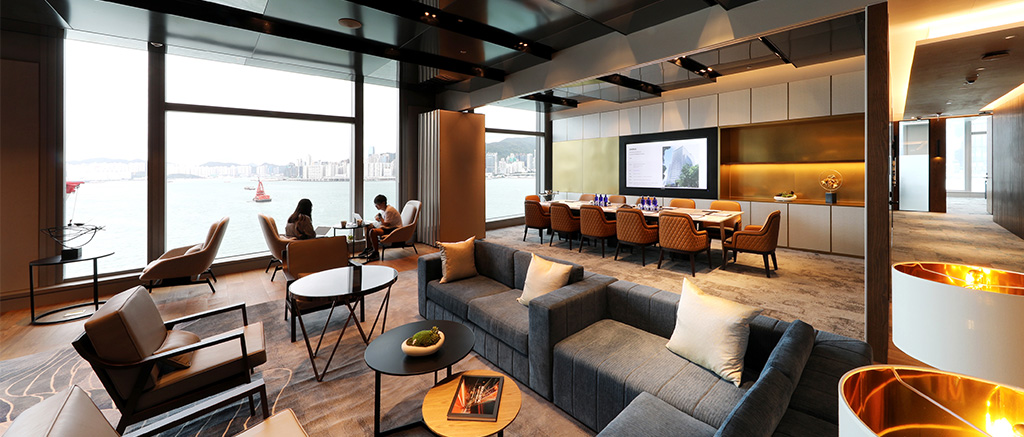
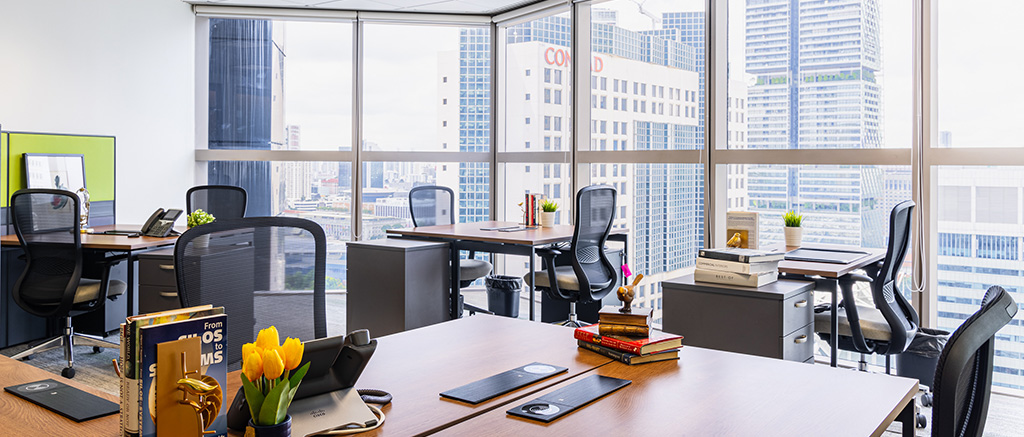
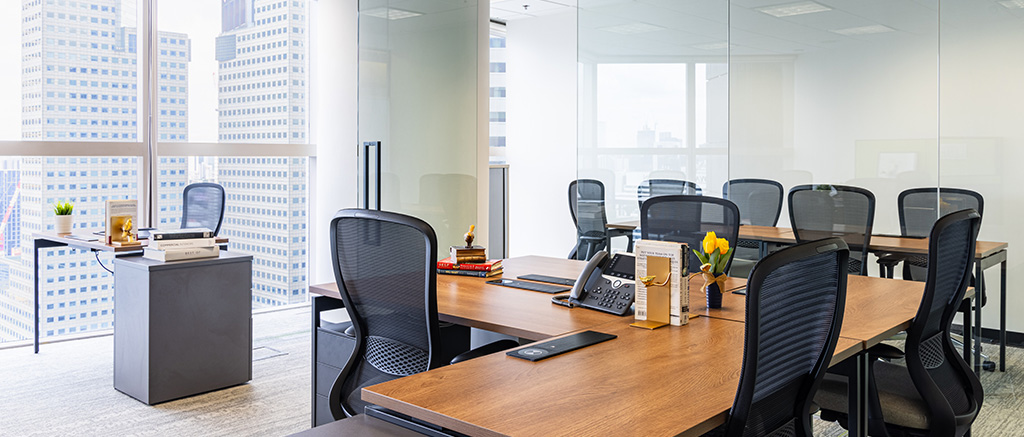
If you want a premium office experience, CEO SUITE is inside K11 ATELIER, a 66-storey 7-star mixed-use tower. Occupants enjoy panoramic views of Victoria Harbour, direct access to East Tsim Sha Tsui Station, 8+1 VIP lifts, and 1,000 parking spaces. It’s also only 28 minutes to Hong Kong International Airport. An impressive location for employees, clients, and target consumers. Check prices here.
How’s the Central Business District?
Central is the heartbeat of Hong Kong’s financial and corporate ecosystem. It hosts the headquarters of international banks, investment firms, law practices, and multinational corporations. Iconic landmarks like the International Finance Centre (IFC), Cheung Kong Center, and Bank of China Tower are also found here.
Office spaces in Central range from full‑floor leases in landmark skyscrapers to modern flexible office setups, albeit at some of the highest rental values in the region. The advantages are substantial: proximity to top-tier clients, direct access to financial institutions, and the ability to network …. Central is ideal for similar niche corporate startups that want to position themselves among high-profile partners.
Transport is equally impressive. Multiple MTR lines, the Airport Express, ferry terminals, and an extensive elevated walkway system provides easy commuting options for staff and visitors. The area also offers lifestyle and convenience advantages. It has luxury retail and fine dining, and a home to cultural attractions like the Former Legislative Council Building and Statue Square.
If you’re ready to play with the big leagues, Central is where it all happens.
Comparison & Decision Guide: Best Fit For Your Business
Wherever you set up your first office in Hong Kong already impacts your business’ success. Aside from rent prices, factors like brand image, networking potential, and strategic location play an equally important role.
The table below provides a concise side-by-side comparison guide of Tsim Sha Tsui (TST) and Central to help you evaluate which district aligns with your business goals.
Factor
Tsim Sha Tsui
Central
Average Rent
Lower / Flexible (~HK$29‑39 psf/m)
High / Premium (~HK$75‑140+ psf/m)
Business Image
Energetic and approachable
Professional and prestigious
Ideal For
Startups, creative teams, and retail brands
Finance, law, and international HQs
Networking Potential
Diverse mix of local and cross-border contacts
Elite corporate circles and investors
Transportation
Excellent (airport & Kowloon)
Excellent (Island hub & business corridors)
When interpreting this table, it’s clear that TST and Central appeal to different business priorities. TST’s flexibility in lease options and lower average rent allows smaller teams to secure office space in a bustling, highly visible environment. The networking opportunities are broad, spanning both local connections and cross-border contacts, which is ideal for companies looking to grow quickly by interacting with a variety of clients.
Central, on the other hand, appeals to firms that prioritize reputation and professional image. Companies with a focus on finance, law, or multinational operations gain credibility simply by having an office here. While the rents are higher, it pays being near influential executives and investors. Many see it as an investment for stronger brand presence and client confidence.
Both districts are highly accessible. Employees, clients, and partners can reach you conveniently with access to different routes.
Quick Decision Tips
Choose TST if cost efficiency, client visibility, and a vibrant work environment are priorities.
Choose Central if reputation, investor confidence, and a professional corporate setting matter most.
Go hybrid! Some companies combine the two: Central for strategic headquarters, and TST for operational or client-facing teams.
Think about the way you want people to experience your brand. That clarity will point you toward the district that helps your business hit the ground running.
And if your path points toward TST, CEO SUITE’s thoughtfully designed full-serviced workspace at K11 ATELIER gives your team a refined, ready-to-move environment. Check it out here.
Should Startups Invest in a Private Office Early On?
Jan 21, 2026
Every founder knows that building a company means constantly making trade-offs. On a daily basis, You’re balancing burn rate with growth, agility with structure, and scrappiness with scale. Somewhere along the way, you’ll ask:
Should we keep working remotely, or is it time to invest in a private office?
It’s a big decision, and for early-stage startups, it’s often a risky one. A private office can be a huge step forward in focus, professionalism, and team culture. But it can also become an expensive commitment that’s hard to unwind if things don’t go as planned. This is the reason why most founders are hesitant.
Most startups begin from home offices, coffee shops, or shared co-working desks. It’s lean, low-cost, and flexible. All the good things when you’re just getting off the ground. However, as your team starts to grow, the limits of those environments become clear.
Meetings get interrupted. Focus gets scattered. Team communication slows down. And when you’re trying to impress clients or investors, the backdrop of a noisy café or crowded co-working lounge doesn’t exactly inspire confidence.
At the same time, making the jump to a private office isn’t a simple decision either. Traditional leases offer control at a cost. You’re locked in, responsible for fit-out, and tied to terms that don’t account for the unpredictable nature of startup growth. For example, a standard three-year lease can become a financial burden if you need to pivot or downsize after just one year.
That’s the challenge: finding a space that supports your business today without limiting your options tomorrow.
Once you’re managing more than five or six people, the communication overhead increases. Working together in one place can improve collaboration and productivity.
Increased Meeting with Clients and Investors
First impressions matter. A polished, professional space improves your credibility.
Handling Sensitive Data
If privacy, security, or compliance are part of your business, it’s harder to manage that in open or public spaces.
Building Company Culture
Culture can absolutely be built remotely, but face-to-face time accelerates trust, team bonding, and alignment.
Struggles in Coordination
If your current setup leads to missed messages, delayed responses, or fractured teamwork, a shared workspace can restore focus.
Not all startups will hit these at the same time, but if two or three resonate with you, it might be time to think seriously about your office.
A strong brand presence isn’t limited to your website. Your office becomes a reflection of your ambition, and it sets the tone in every pitch, meeting, or interview.
2. Faster Execution
When your team works from the same space, decisions move faster. Momentum is built because there is less back-and-forth.
3. Operational Control
From internet speed to meeting room availability, private offices eliminate the friction of shared spaces so you can operate on your terms.
4. Cultural Identity
As your team grows, culture doesn’t scale on autopilot. A private space gives you the physical environment to reinforce values, routines, and team identity.
5. Retention and Engagement
Top talent often seeks structure and flexibility. A well-designed office provides a place people want to work from without making it mandatory.
Risks of Committing Too Early
It’s tempting for startups to treat a private office as a milestone. It’s a space to bring investors, rally the team, and put down roots. But that sense of legitimacy can be costly if the business isn’t ready. Lock in too early, and what feels like progress can quickly become a liability.
One of the most immediate risks is financial pressure. Fixed rent, utilities, and maintenance can create strain on both budget and morale, especially when revenue is still inconsistent.
There’s also the challenge of space mismatch. Many startups move in before they’ve figured out their ideal team structure or work style. An office that fits five people today might be too small or too large in just a few months. Being locked into a lease that doesn’t match the pace of growth can leave a company paying for space it no longer needs or scrambling to find more before the lease allows for it.
And while the idea of having a place to “bring the team together” is appealing, the reality is that managing an office requires time and attention. For founders already stretched thin, taking on those responsibilities too soon can pull focus from the core work that drives growth: building the product, finding users, and solving their problems.
The Smarter Option: CEO SUITE
The smartest workspace decision for early-stage startups lies in the middle: flexible serviced office. It offers the structure of a private office without the rigidity of a long-term lease and financial or operational burden of traditional setups.
CEO SUITE gives startups exactly that. You get all the benefits of a professional setup, with none of the risk.
Your team’s potential shouldn’t be limited by your workspace.
For a growing startup, choosing your office is a strategic decision. Traditional leases can limit your agility just when you need it most. Instead, consider a flexible office solution. Serviced spaces, like those offered by CEO SUITE, provide professionalism and stability without locking you into long-term commitments or hidden costs. Explore your options here.
Every square foot of office space you occupy should serve a bigger business goal.
Maybe your team could have outgrown remote work, client meetings are starting to require a more professional setting, or you’re expanding into a new market and need a physical base to operate from. Whatever the reason, having an office should secure the efficiency of work operations and productivity of the team.
Now the question is: Should you lease or buy?
The Basics Between Lease and Buy
As your business grows, so do your needs. Deciding whether to lease or buy an office space is a strategic business decision. Beyond your core operations, it affects your financial health, flexibility, and company culture.
Buying on the other hand, means you own the building. You have full control over the space and can customize it to fit your brand and culture. Plus, you build equity over time.
In contrast, buying requires a larger investment: a down payment, closing costs, and renovation expenses. Ownership can become more cost-effective over time, especially if property values rise or you stay put long enough to offset the initial cost.
2. Flexibility
Are you scaling your business? Testing new markets? Figuring out the team size? If so, you can scale up, down, or move as needed through leasing.
If you’re confident in your long-term location and space needs, ownership locks in stability. But if your plans shift, selling or renting out your property adds complexity.
3. Control
Leasing means working within someone else’s rules. You might be limited in how much you can brand or build out of your space. If you need to knock down a wall or reconfigure the layout, you probably need landlord approval and pay for it.
Buying gives you complete control. You can design the space around your branding as you set the ambiance for a client-friendly environment. Of course, with that control comes responsibility: maintenance, upgrades, and any surprises (like a leaking roof) are on you.
4. Company Culture
Your workspace has a direct impact on how your team works and how your clients perceive your business. A fully-branded office can boost morale and a sense of pride in the workplace. Meanwhile, leasing limits how much you can accommodate team preferences.
The Best of Both Worlds
What if you don’t want to choose either of the two?
Maybe you’re opening in a new city, and are not quite ready to buy, so locking into a long-term lease feels too rigid for where your business is right now. That’s where CEO SUITE steps in.
We offer fully serviced offices, meeting rooms, co-working setups, and even enterprise-ready spaces so you’ll have what you need when you need it. It’s the smarter middle ground between leasing and buying an office space. You’ll get:
A well-known business address
Flexible terms
Ready-to-use offices
State-of-the-art technology
On-site support
No long leases. No massive upfront costs. Only a professional setup that lets you focus on your business, not on the building you reside in.
Conclusion
There’s no perfect answer that fits every company.
Leasing and buying both have their place. To know which fits best for your business, determine the stability of your company, your long-term plans, and how much flexibility you need.
But if you want an office solution that doesn’t box you in, but rather make you look and operate like the real deal, CEO SUITE can give you exactly that. Check out our services to learn more here.
Reasons Why International Firms Should Enter China
Mar 05, 2019
As the second largest economy in the world with a population of more than one billion, China is too big and too attractive for both Western and Chinese investors to overlook. China’s economy has grown significantly in the last two decades and it is now a global leader. With a share of global Gross Domestic Product (GDP) just behind the United States, the country has an important role in world trade. To sustain its fast-growing economy, it has shifted its priorities to focus on growth, transitioning from manufacturing to services and from labor-oriented jobs to technology-oriented ones. In addition, the Belt and Road Initiative (BRI), a plan to improve transportation connections between China and its neighbors, will likely contribute to advancing the global economy. Most importantly, government decisions and regulations, such as financial tightening and supply policies, have validated China’s commitment to growth and desire to remain an essential and productive participant in the world economy.
These factors make China extremely favorable for prospective investors. CEO Suite, Asia’s only one-stop service office provider run by multi-cultural industry experts, has identified some important reasons why prospective investors should consider investing in China.
Availability of capital
In early 2000, almost 20 years ago, China surpassed the United States as the world’s largest beneficiary of foreign capital. Certain conditions in the global capital markets along with a booming economy have led to large amounts of investable capital for China, which are important prerequisites for determining the flow of foreign investment in the country. This influx of capital is attractive to foreign investors and is enticing to international businesses that want to invest in emerging and profitable markets.
Political and economic stability
Political and economic stability in China means consistency and predictableness for investors, which allows for better insight into the future. Since instability could lead to inflation and problems like social unrest that are not conducive to business, both local and foreign businesses appreciate and value China’s environment for law and order. This backdrop not only encourages investments in China, but promotes more efficiency in trade activities as well as long-term growth.
Regional and international trade
Of great importance to foreign investors is the ability to sell products and services regionally and internationally. Besides China’s free-trade zones, other advantages for investors include tax exemptions and free conversion of Chinese currency to any international currency. M, export policies play a key role in deciding whether to enter China, especially for investors anticipating a large market share outside of the local market. China’s regional and international free trade agreements are alluring for stimulating economic activity and business growth.
Large local market
The most attractive feature for investing in China is the sheer size of the country’s large population and, therefore, the great possibilities for growth. As it continues to evolve and mature, investors can expand and profit in many high-end industries, including information technology, engineering, healthcare, robotics, and luxury goods. Opportunities for foreign investors in prospective and current commercial activity will provide positive effects on sustaining business.
Infrastructure and workforce
China’s infrastructure and availability of resources and labor contributes to its appeal for investors. A developing economy requires these to facilitate the sale of goods and services. Roads, bridges, and other physical structures allow for transportation of goods. An educated and competent workforce contributes to success, as well. China’s labor market continues to obtain educations from universities and to become more knowledgeable. These elements enable investors to spend less and make more. And, with employment opportunities comes more income for spending. China’s retail sector persists as foreign investors across all industries open retail locations to benefit from this spending.
There is great opportunity for Western and Chinese investors in China this year as the country continues to create a promising environment for business. Once you decide to invest in China, CEO SUITE can help you maximize your investment. Asia’s one-stop service firm customizes solutions to help businesses of all sizes easily enter China and expand throughout the country with few issues.
Please contact us to discuss expanding your business in China.
It is evident today how many start up and small businesses begin and continue operating their businesses from the comfort of their homes. As convenient as it is, it is important to consider having a different address for your business apart from your own personal home. Setting apart your business from your personal life and space can do wonders in organization of your company and personal life, privacy, and most of all, professionalism.
PRIVACY
Privacy is one of the many important issues that need to be addressed by an entrepreneur who is operating his/her business in the premises of his/her home. Business addresses are public, and should be available to not only your current clientele but also to everybody who might be considered as your “potential” customer and it is most probable that you prefer to keep your home private. Using your home address as your business address means you would have to put the same address to your business cards, website, advertisements and just about everything to help spread the word about your business. This means your home address is known to the public, just about anybody can have access to this information.
ORGANIZATION
Setting your business and personal home and space apart will aid you in keeping everything in order. It is beyond your control how many mails will end up piling on your address. Just imagine, if you have a separate address for your business, you can have your business documents stay all together and separate from all your personal ones. It will also save you time to scan through all the mails and separate and organize them one by one.
PROFESSIONALISM
Although first impression doesn’t always last, first impressions still matter. Companies who would like to work with you, whether for a collaboration, or get your company as a vendor, giving them your home address would not give a good image. It will, in fact, give them the notion that you are a small time business and may not have the capacity to provide them the services or products they need, especially if the demand increases. By having a professional business address, you will have the advantage of making your business look more official and trustworthy. It will send out an image that says you are established and that whatever mails they send you will be handled professionally and answered quickly.
Having a professional business address (and a prestigious one at that), is one of the many steps you must consider to take if you are setting up your business for the big jump. The small effort to finding yourself a virtual office that offers prestigious business address could help you greatly in the long run.
20 Years of Providing Premium & Luxurious Serviced Offices in Asia
Jan 11, 2017
It has been 2 decades when financial crisis stunned Asia’s business foundations- the time when CEO SUITE had started with only one business centre in 1997, and has since then grown and considered to be the industry leader and the first choice for global workplace with Premium Business Centres across Asia, catering to various industries.
Ever since being established in 1997, CEO SUITE has devoted its life and existence to incomparable hospitality- wherein hands-on management mainly focuses on clients’ needs and details. The company believes that to remain the best in the industry and to incessantly grow even more, clients’ satisfaction is of top most priority.
Now with over 20 years of service, CEO SUITE continues to ensure clients’ satisfaction through providing value in service experience, offering the best business locations, investing and providing luxurious and state of the art facilities and technologies, and delivering highest quality of care and reliability towards CEO SUITE team across all Premium Business Centres in Asia. Hundreds of Blue Chip Multinational companies have witnessed and experienced the CEO SUITE difference.
Living up to its vision to be come the first choice for global workplace solution, and its mission to be an enabler of excellence for clients, their team and the community, CEO SUITE holds dear the company values in each tasks for every client: Sense of Urgency, Care, Openness, Ownership, Trust and Teamwork.
Now with larger network base and reach, CEO SUITE provides different services for all client needs- whether it is serviced offices, instant offices, virtual offices, meeting/boardrooms, and professional services for their businesses, CEO SUITE has it. The variety and flexibility of CEO SUITE offerings range from an office space good for one person, or a larger office fit for a requirement of 50 employees to work in at. CEO SUITE Premium Serviced Offices offers layouts for private managerial suites, to open space plan layouts and customized arrangements for a more cost-efficient approach fit for rising and new businesses.
Enabling not only large scale businesses to grow, but also providing better opportunities for small scale and new companies to excel, CEO SUITE furnished offices are offered in customizable options- can be rented daily, weekly, monthly or on a yearly basis- whatever is the most suitable for any business.
For businessmen with sophisticated tastes and only aim for perfection, CEO SUITE is the perfect solution. Experience the CEO SUITE service excellence, enquire now at www.ceosuite.com.
There are so many tricks and tips you can use when you are in search for an office space.
Having an office space can drain your company’s resources. For start-ups, it may not be advisable to pursue except for unique business solutions that may be available.
Standard commercial real estate companies usually demand 5-20 years of lease terms, not so much of an ideal requirement to new businesses who are in need of more growth opportunities and do not need extra and binding liabilities.
Although there are other factors and things a business can consider to minimize cost and maximize profits, such as downsizing personnel, the office space plays a major role in the financial budget of any company.
Any startup entrepreneur or business should know that nowadays, leasing covers and talks about more than just getting a workspace. Just like times have changed, business’ needs aren’t always now fit to operate in a plain and bare commercial space.
The rise of serviced offices and virtual offices have changed the way people and business work and function. There are also shared offices, which some call Co-Working Spaces, where terms of payments and leasing requirements are flexible while also giving better opportunities for other business networking matters. Many big companies today have also started their way from leasing co-working spaces, some even started on sticking to working at home and just getting their companies a virtual office while continuing to work on the growth of their businesses.
The main reason startup businesses should not commit to a conventional office space is the big chunk of liquidity lost. Imagine a small business, having just enough to continue operating everyday with high hopes of many opportunities to open being required to give away half, sometimes even more so, of their liquid cash just for an office space, which still needs so much work to polish with furniture, facilities, and appliances every office needs. Getting rid of high operating costs like this is a big breather for small companies, which in return frees up capital and enables these small and start up businesses to do more and stay liquid.
Commonly, many businessmen mistake these types of offices (serviced offices, virtual office, shared offices) as only an office for certain types of businesses, such as small ones, startups, businesses that are offering services too. Truth is, these types of offices cater even to big and multinational companies, as these types offices offer them chances to branch out internationally with more ease, comfort and assistance. These types of offices are usually equipped with a workforce that is hired to focus on aiding your needs. Also, these types of offices are usually present in prestigious business addresses and places, better computers, communication technologies than what you or your company could afford alone. These types of offices are like an “easy in, easy out” set-up between companies and themselves, offering less hassle and faster turnover which enables companies to start working, functioning and operating in no time. It is simple a commercial space that delivers you value and truth in “start working right away” promises, getting you equipped straight down to business.
Settling in for a serviced office, or a virtual office, or a shared office space is a cost-effective solution to your office space dilemma, especially when you are the type of business or company that needs to avoid the trials and ordeals of a traditional / conventional property letting such as a wowing 20 years of lease contract, getting reliable references, big amount of deposit requirements, personal guarantees from directors, min. size requirements you have to lease, cost of equipment and furniture to fill in the bare office space. Most of all, beyond the budget you need to allot for your serviced office / virtual office, or shared office space, do not forget that what you paying for goes beyond just the physical aspect of it. You are buying time, paying for more time you can well use for other things — say more important ones, like sales, networking, partnerships, and the likes, than allotting those time for setting up a plain and bare office space.
Are you a foreigner or with a foreign-registered company planning to put up a business in the Philippines?
Sep 21, 2016
Here are some smart tips on foreign ownership/equity restrictions to get you started:
The Philippines has been traditionally known to restrict foreign ownership of companies to 40% of total equity only, with 60% equity reserved for citizens. The government, however, has initiated actions in the past to relax this rule in order to attract foreign investments to help grow the country’s economy.
This guide is intended to help prospective foreign investors and/or their local partners or agents to determine how much foreign equity is allowed in their line of business.
1. First thing to check: Foreign investment negative lists
The first law liberalizing foreign investments (Foreign investment act of 1991) resulted in the creation of a foreign investment negative list (FINL) that seeks to define restrictions on foreigner’s and foreign companies’ economic activities in the country.
The FINL is regularly updated and is now on its tenth revision to reflect new laws. The list is divided into two as follows:
[accordions_dd expanded=’0′]
[accordion_dd title=’Negative List A’]
Limits On Foreign Ownership As Mandated By Constitution And Other Laws
No Foreign Equity
Mass Media except recording
Practice of Professions
Pharmacy
Radiologic and X-Ray technology
Criminology
Forestry
Law
Retail trade enterprises with paid-up capital of less than $2.5 Million
Cooperatives
Private security agencies
Small-scale mining
Utilization of marine resources in archipelagic waters, territorial sea, and exclusive economic zones as well as small-scale utilization of natural resources in rivers, lakes, bays, and lagoons
Ownership, operation and management of cockpits
Manufacture, repair, stockpiling and/or distribution of nuclear weapons
Manufacture, repair, stockpiling and/or distribution of biological, chemical and radiological weapons and anti-personnel mines
Manufacture of firecrackers and other pyrotechnic devices
Up to Twenty Percent (20%) Foreign Equity
Private radio communications network
Up to Twenty Five Percent (25%) Foreign Equity
Private recruitment, whether for local or overseas employment
Contracts for the construction and repair of locally-funded public works
Infrastructure/development projects in RA 7718:
Projects which are foreign funded and required to undergo international competitive bidding
Contracts for the construction of defense-related structures
Up to Thirty Percent (30%) Foreign Equity
Advertising
Up to Forty Percent (40%) Foreign Equity
Exploration, development and utilization of natural resources
Ownership of private lands
Operation of public utilities
Educational institutions other than those established by religious groups and mission boards
Culture, production, milling, processing, trading except retailing, of rice and corn and acquiring, by barter, purchase or otherwise, rice and corn and the by-products thereof
Contracts for the supply of materials, goods and commodities to government-owned or controlled corporation, company, agency or municipal corporations
Facility operator of an infrastructure or a development facility requiring public utility franchise
Operation of deep sea commercial fishing vessels
Adjustment companies
Ownership of condominium units
[/accordion_dd]
[accordion_dd title=’Negative List B’]
Limits On Foreign Ownership For Reasons Of Security, Defense, Risk To
Health And Morals And Protection Of Small-Medium Scale Enterprises
Up to Forty Percent (40%) Foreign Equity
Manufacture, repair, storage, and/or distribution of products and/or ingredients
requiring Philippine National Police (PNP) clearance:
Firearms, parts of firearms and ammunition therefore, instruments or implements used or intended to be used in the manufacture of firearms
Gunpowder
Dynamite
Blasting supplies
Ingredients used in making explosives
Telescopic sights, sniper scope and other similar devices
Manufacture, repair, storage, and/or distribution of products requiring
Department of National Defense (DND) clearance:
Guns and ammunition for warfare
Military ordinance and parts thereof
Gunnery, bombing and fire control systems and components
Guided missle/missle systems and components
Tactical aircraft, parts and components
Space vehicles and component systems
Combat vessels and auxiliaries
Weapons repair and maintenance equipment
Military communication equipment
Night vision equipment
Stimulated coherent radiation devices, components, and accessories
Armament training devices
Others as may be determined by the Secretary of the DND
Manufacture and distribution of dangerous drugs
Sauna and steam bathhouses, massage clinics and other activities regulated by law because of risks posed to public health and morals
All forms of gambling except those covered by investment agreements with PAGCOR
Domestic market enterprises with paid-in capital of less than the equivalent of USD$200,000
Domestic market enterprises which involve advanced technology or employ at least 50 direct employees with paid-in equity capital of less than the equivalent of US$100,000
[/accordion_dd]
[/accordions_dd]
2. Domestic Corporations and Subsidiaries
Up to 100% foreign ownership is allowed for domestic corporations that:
Are not part of the foreign investment negative lists
*Note that retail businesses (selling directly to consumers) with less than $2.5 Million in paid-up capital is listed under Negative List A.
Have at least the peso equivalent of USD $200,000 in paid-in equity capital.
This amount can be reduced to USD $100,000 if :
the enterprise employs 50 employees or
if it will be using “advanced technology”—to be determined by the Department of Science and Technology.
3. Retail Trade Enterprise
Retail Trade Enterprise are businesses that sell directly to consumers.
Category A: Have a paid-up capital of USD 2.5 Million or more
Category B:Specializing in high end or luxury products, provided that the paid-up capital per store is not less than USD 250,000.00 (Sec. 5 of R.A. 8762)
Additional qualification requirements for foreign retailers can be found below:
Parent company with USD 200M net worth (USD 50M net worth for luxury brands)
At least 5 branches or franchises around the world OR at least one store capitalized at a minimum of USD $25M
Five year track record in retailing; and
Only nationals from, or juridical entities formed or incorporated in Countries which allow the entry of Filipino retailers shall be allowed to engage in retail trade in the Philippines.
Finally, all retail trade enterprises under category A that exceeds 80% foreign equity must list and offer a minimum of 30% equity in any stock market in the Philippines. This should be done within 8 years from the company’s start of operations.
4. Export Businesses
100% foreign ownership is allowed for export businesses, as long as it doesn’t fall under the negative lists. A business is considered as an export business if at least 60% of its output or sales are exported.
Call centers, BPOs, KPOs, back offices and similar businesses can all be considered as export businesses provided they adhere to the output rule.
Export businesses can also claim tax incentives via various laws (EO 226 / Board of Investments, PEZA law, and other economic zone laws)
We wish to remind the reader that this content should serve as a rough guide only and not to be used as proper legal advice. Please get in touch with an attorney to get specific advice for your situation.
How Mobile Technology has Revolutionized Business Travel
Sep 20, 2016
With modern technology, business travel has become even more convenient for everyone. However, it has also become the justification for some companies to cut-back on costs spent on business trips for their employees since most business transactions nowadays can all be done online.
Looking at the brighter side, with the advancement of mobile technology, being out on long business trips abroad is no longer a hindrance to the smooth operations of any business. All our office emails, business reports and client presentations can now be done via our high-tech mobile gadgets that all have high speed internet and data connectivity. Video conferencing anytime is no longer an issue since we all have Skype on Mobile or Facebook Video. Viber calls and phone messenger applications like Facebook Messenger, WhatsApp or Line are readily available for instant communication requirements regardless of geographical location.
Business travel has changed so much throughout the decades, made even more possible with the entry of budget carriers worldwide. Same day return flights often required by business travelers have been accommodated by carriers with the opening of early morning/dawn flights and “red eye” (midnight) flights so that the work day can be maximized efficiently. Even baggage requirements of frequent business travelers have also been taken into account by airlines who now offer fares with hand carry luggage only at discounted rates. Airline frequent flyer programs have improved member benefits including dining offers, car rentals and other travel-related benefits. Online flight and hotel booking mobile phone applications are available for immediate business trip requirements – every change in the trip itinerary can be done with a single click of a button on one’s mobile device. Hotels have also created a new category – business hotels or boutique hotels – have proliferated globally to address this need for basic hotel commodities by business travelers; and loyalty programs have been developed for corporate clients to attend to their regular travel needs who also extend special discounts.
Another interesting development is the proliferation of premium business centers, not just at the airports, but also in the CBD areas where one can catch up on work while relaxing at prestigious business lounges or private office suites with high-speed Internet, free-flowing coffee and tea, as well as document printing/scanning facilities. Meeting rooms for small or big groups are also available for hourly or daily use. In Asia, one of the finest providers of this unique service is CEO SUITE that has 19 premium business centres in the CBD areas of Singapore, Jakarta, Makati, Kuala Lumpur, Bangkok, Hanoi, Seoul, Shanghai and Beijing.
Indeed, everything you need is just there, making it a seamless journey for businessmen who need to travel the globe regularly. As a jetsetter, you know what you need whenever you travel and as long as you have your mobile phone working, plus, all the apps you require to book a flight, a hotel, a car rental, etc., you are all set for the whole calendar year. Just make sure, you also get to insert some leisure time along the way to make the journey less exhausting and more meaningful.
Is Franchising Business For You? Tips in Getting a Franchise
Sep 15, 2016
For those business-minded people or entrepreneurs who are eyeing to start up their own business, getting franchise businesses can be a good alternative. It has lesser risk than that of starting your own brand or business from scratch. The great thing about getting a franchise is that almost all the work is done — the business plan; established and strong recognition of brand name is already evident. Plus, most of the marketing and advertising efforts are mostly done by the franchisor, which you can consider as reduction to your operation budget already. Nevertheless, just like any new business, there is a still risk you may have to consider. Though getting a franchise also buys you a lot of time and things to do, your business’ success still relies on you.
Here are a few tips you may want to consider before taking a franchise business:
1. Do your research.
You are solely responsible for the due diligence before you invest, as Founder and CEO of CorpNet.com, Nellie Akalp said. Your knowledge and skills are your weapons in the business warzone. Though getting a franchisee may seem to be easy because almost all the hardest work are done, it is still important that you keep updated about things before investing. Know about the company or brand you intend to franchise, it pays to check thoroughly the franchisor’s capacity to support you. Another thing to research about is the company’s solid track record, it is always better to go for a franchise of a business whose operations and sales are proven successful.
2. Consult a Specialist.
Do not just give in to charismatic franchise agents offering you franchise businesses. It is very important that you are ready and that you have studied the concept of the business franchise that is being presented to you. You can get help in reviewing the contracts carefully by a lawyer, the numbers by the accountant or a business development advisor who has extensive experience in the franchising industry. You should know exactly what you are getting yourself into before giving it your hard-earned money.
3. Know your net worth and liquid capital.
Having a bigger bank account is usually more attractive to franchisors than having bigger assets. You must be confident that you are liquid enough to keep your franchising business going despite off seasons of the business.
4. Be open to learning and socialize with like-minded individuals.
You can never really learn much by yourself. To see and know more about what’s on offer, it is vital that you meet the right people in the industry. Attending seminars, trade shows and the likes provide a lot of help. This way, you can also widen your horizons, and know about other companies you may not have crossed path yet with who actually offer better deals.
The best way to experience CEO Suite is to visit us in person. Kindly complete the form, our team will contact you to better understand your requirements.
Your amount to pay has been updated
The previous conversion quote has expired. Here is your new quote: